
What You Build Before You Have the Proof
 Maria Quiroga
- Client
- Nibble ONE
- Industry
- Catering & Restaurant Software
- Services
- Positioning & Messaging, Landing Pages, ROI Proof, Go-to-Market Plan
- Live site
- nibble.io
Most marketing advice assumes you already have something to point at. Show the results. Lead with the case study. Let the numbers do the talking. It’s good advice, and it is completely useless to a company entering a category where the buyers already know three or four established products by name and have never heard of yours.
That was the actual starting position for a catering software client of ours. The category was crowded, some of the incumbents had name recognition and pricing models built around taking a cut of every order, and our client was arguing for a different way of doing business. What they did not have was a shelf of proof points to back the argument up.
The proof problem, said plainly
There is a temptation, in that position, to solve it with adjectives. Better. Smarter. Built for you. It never works, because the buyer has already read those exact words on every competitor’s homepage, and the words cost nothing to write.
The real problem wasn’t messaging. It was that a prospect ends up in a room, alone, having to explain to a boss or a partner why they picked the vendor nobody in the room has heard of. Everything we built had to survive that conversation, in a room we would never be in.
That reframes the work. You are not writing copy that sounds convincing. You are handing a specific person the material to make an argument on your behalf, without you there to help.
One pitch, three buyers
The first thing that had to go was the single pitch. A one-owner restaurant that has quietly built up catering demand, a growing brand running the same operation across a dozen locations, and a company feeding a hospital or a university are not three flavours of the same customer. They have different problems, different words for those problems, and different reasons to say no.
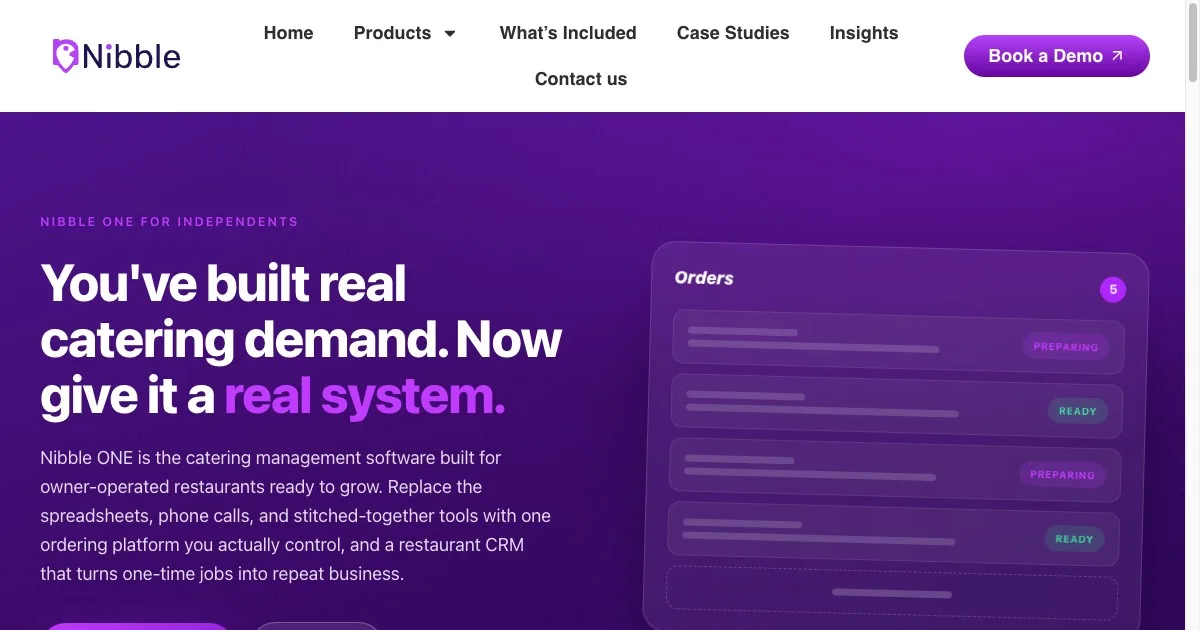
So each one got its own page, written around its own operation. The independent’s page opens on the demand they have already built and the stitched-together spreadsheets and phone calls holding it up. The multi-location page opens on a sharper edge: you took the order, you should keep what it’s worth. The institutional page leads with what those buyers actually get judged on, which is looking professional to a client every single time.
None of that is a rewrite of the same paragraph with the audience swapped. It’s three arguments, because there were three arguments to make.
A number the buyer can defend without us
Then there’s the money, and this is where most software marketing quietly cheats. Anyone can build a calculator that produces a big, flattering number. It takes about an hour and it convinces nobody who has to defend it internally, because the first thing a skeptical finance person does is check the assumptions.
The calculator we built asks for four things a restaurant already knows without looking anything up: how many catering orders a month, what the average order is worth, how many staff hours a week go into running catering, and what an hour of that staff time costs. Nothing exotic, nothing that requires a spreadsheet export, nothing the prospect has to guess at.
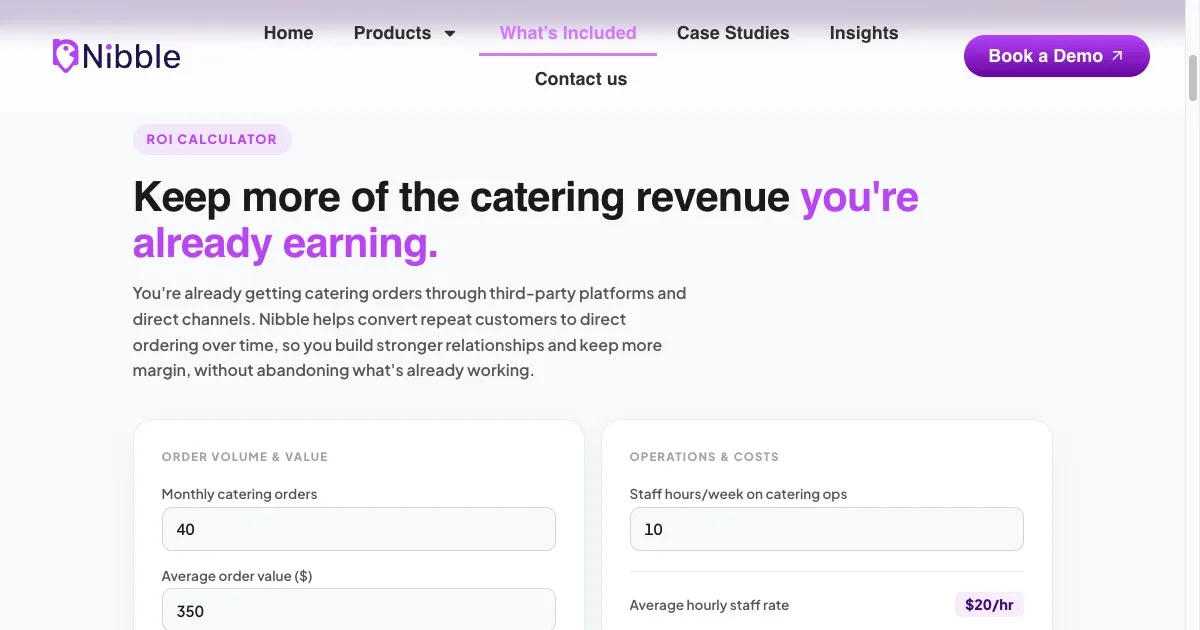
The framing matters as much as the maths: it’s not a projection of new revenue that might appear, it’s how much of the catering revenue the restaurant is already earning stays with them. A number built from the prospect’s own operation is one they can repeat in a meeting we’re not invited to. A number built from our optimism is one they’ll get argued out of in thirty seconds.
Comparison, without the theatrics
The same discipline applied to the competitive work. A buyer looking at this category is already comparing, whether or not the vendor participates, and pretending the alternatives don’t exist reads as either naive or evasive.
What we wouldn’t do is the version everyone has seen: the feature grid engineered so one column wins every row. Anyone who works in the category can spot a rigged table instantly, and the moment they do, every other claim on the page gets discounted too. Comparison earns trust only when the honest answer to “does this competitor do that well?” is sometimes yes.
What exists now that didn’t before
At the end of it, the client has three conversion paths instead of one generic pitch, comparison material that holds up in front of a buyer who already knows the category, a calculator their sales team uses in live conversations, and a ninety-day outbound and content motion running in place of one-off campaigns.
What they don’t have yet, and this is the honest part, is the outcome data. Conversion by segment, win rate against the alternatives, how often the calculator shows up in deals that close, reply and meeting rates from outbound: all of it is being tracked now, and none of it means anything until a full sales cycle has closed. Publishing those numbers today would be inventing them.
The standard, restated
Building the argument before the proof exists is not a workaround for having no results. It’s the only order the work can happen in: the results come from conversations that only start once the argument is good enough to get the meeting.
At Spritz My Duck, this is the standard we hold ourselves to: we build the case a buyer can carry into a room without us, we use numbers that come from their operation instead of our optimism, and when the results aren’t in yet, we say so instead of dressing up the ones we have.